
Intensifying Semi Sector Divergence: The Trilogy of Analog, Digital, and Power
The semiconductor industry is no longer a single, unified story. Instead, it is increasingly a trilogy—three distinct but interdependent sectors whose economics, technology roadmaps, and demand cycles are diverging: analog, digital, and power. On the surface, all three deal with silicon and electrons; in practice, they respond to different customer needs, move at different speeds, and face different constraints.
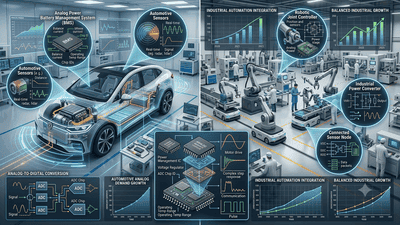
This article examines the structural differences between analog, digital, and power semiconductors, why those differences matter more today than in previous cycles, how the three sectors interact, and what this evolving trilogy implies for strategies in design, manufacturing, and investment.
Three sectors, three missions
At the highest level, analog, digital, and power semiconductors address three fundamental tasks in electronics: sensing and interfacing with the real world, computing and controlling information, and converting and delivering energy. Each has a distinct mission, which translates into different design priorities and technology choices.
Analog: bridging physics and bits. Analog chips deal with continuously varying signals—voltages, currents, frequencies, and waveforms. They live at the boundary between physical phenomena and digital representation. Operational amplifiers, data converters, sensors, RF front‑ends, and many mixed‑signal devices fall into this category. Precision, noise performance, linearity, and robustness under real‑world conditions matter more than raw transistor density.
Digital: orchestrating logic and computation. Digital chips manipulate discrete states—0s and 1s—in ever more complex architectures. CPUs, GPUs, FPGAs, AI accelerators, microcontrollers, and digital signal processors are part of this world. Here, performance per watt, throughput, memory hierarchy, and architectural innovation dominate, and leading‑edge process nodes play a central role.
Power: shaping and delivering energy safely. Power semiconductors manage the flow of energy—switching, converting, protecting, and controlling electrical power for motors, batteries, chargers, inverters, and more. MOSFETs, IGBTs, gate drivers, and wide‑bandgap devices such as silicon carbide (SiC) and gallium nitride (GaN) reside here. Efficiency, thermal performance, voltage handling, and reliability under stress are key.
Historically, these sectors were intertwined in broad market narratives. Today, their trajectories are diverging more sharply, driven by structural trends in AI, electrification, connectivity, and industrial policy.
Diverging technology roadmaps

One of the clearest signs of intensifying divergence is how the three sectors approach process technology and design roadmaps.
Digital: relentless node scaling and architectural churn. Digital semis ride the wave of advanced nodes. Every few years, new process generations enable smaller, faster, and more energy‑efficient transistors. Architectural innovation—cores, accelerators, interconnect fabrics, chiplets—proceeds in lockstep with these node transitions. The digital roadmap is characterized by short product lifecycles, aggressive performance targets, and intense competition at the frontier.
Analog: slower, more selective node migration. Analog often thrives on mature nodes. Shrinking devices can hurt precision, increase mismatch, and complicate analog layout. As a result, many analog products remain on well‑understood process technologies for long periods, emphasizing design skill over raw scaling. Node transitions occur selectively, where they truly improve performance or integration rather than purely following the digital roadmap.
Power: material and structure innovation over node race. In power semis, the major breakthroughs come from materials (SiC, GaN) and device structures (trench, super‑junction, vertical architectures) more than from moving to ever smaller geometries. Voltage handling and current capacity often favor larger features optimized for robustness. Roadmaps focus on efficiency gains, thermal management, and ruggedness, not on chasing the tiniest transistors.
These differing trajectories mean that fab investments, R&D priorities, and talent needs are fragmenting. A plant optimized for advanced digital nodes is not automatically well suited for analog or power; likewise, the most critical analog and power expertise lies in circuit and device physics rather than deep sub‑micron lithography alone.
Distinct demand drivers and cycles
Analog, digital, and power semiconductors now respond to different demand drivers and exhibit increasingly distinct cycles, creating divergence in growth patterns and risk profiles.
Digital demand: AI, cloud, and consumer compute. Digital semis are closely tied to data creation, processing, and consumption. AI training and inference, cloud infrastructure, PC and smartphone refreshes, gaming, and networking all shape demand. Cycles can be sharp: surges in AI investment or new platform launches drive booms, while pauses in enterprise spending or consumer downturns cause corrections.
Analog demand: sensing, control, and connectivity everywhere. Analog sits in the background of many systems: industrial automation, vehicles, consumer devices, medical equipment, communications, and more. Demand often grows steadily as more things are instrumented and connected, but is sensitive to broader industrial and automotive cycles. Analog content per system can rise even when unit volumes fluctuate, supporting relatively resilient long‑term growth.
Power demand: electrification and energy transition. Power semis are directly linked to electrification trends: electric vehicles, renewable energy integration, industrial drives, data‑center power management, and building efficiency. As the world electrifies transport and shifts to low‑carbon energy, power device content per system climbs. Cycles here are shaped by policy, infrastructure investment, and automotive platforms more than consumer sentiment.
While all three sectors can experience broader macro impacts, their primary drivers increasingly differ. A downturn in smartphone sales may hit digital heavily while leaving power demand from EVs and solar inverters relatively intact. Conversely, a slowdown in industrial capex might weigh on analog and power more than on certain data‑center‑focused digital lines.
Divergence in economics and business models

The trilogy sectors also diverge in economics—margin structures, capital intensity, and typical business models.
Digital economics. Advanced digital requires heavy upfront R&D and high capital intensity for leading‑edge manufacturing. Margins can be strong when performance leadership is maintained, but competition is fierce and product lifecycles short. Business models often involve large design wins, platform tie‑ins, and substantial software ecosystems.
Analog economics. Analog can be highly profitable, with durable product lines and long lifecycles. Once a part is designed into a system—particularly in automotive or industrial—it can generate revenue for many years with relatively modest incremental R&D. The economics favor breadth of catalog, application support, and close customer relationships more than constant node upgrades.
Power economics. Power devices often occupy a middle ground: they demand significant process and materials investment, especially for wide‑bandgap technologies, but can secure strong margins when tied to high‑value systems like EV powertrains or industrial drives. Business models may hinge on deep collaboration with OEMs to meet efficiency, safety, and reliability requirements.
These differences are intensifying as each sector leans into its strengths. Analog players expand catalog and application scope; digital players double down on platform ecosystems and data‑center relationships; power players drive material innovation and partnerships in automotive and energy domains. Investors, in turn, increasingly value these sectors differently, recognizing that “semi” is not a single homogeneous category.
Supply chain and manufacturing divergence
Divergence shows up in where and how chips are made and packaged, and in the types of fabs and suppliers involved.
Digital manufacturing. Leading‑edge digital production concentrates in a select set of advanced fabs, often with large capital commitments and tight integration with global foundry hubs. Packaging is increasingly sophisticated—chiplets, interposers, high‑bandwidth memory integration—requiring advanced back‑end capabilities.
Analog manufacturing. Analog frequently uses mature and specialty nodes, sometimes in regional fabs focused on automotive and industrial customers. Packaging requirements can vary widely but often emphasize robustness and environmental resistance rather than ultra‑high‑density integration.
Power manufacturing. Power devices may be produced in dedicated lines optimized for high‑voltage and high‑current handling, using specific materials and process flows. Packaging is central: modules, power stacks, and thermal management solutions are key differentiators, and packaging houses that specialize in power electronics play an important role.
As industrial policies and onshoring incentives proliferate, these manufacturing footprints diverge further. New digital fabs may cluster in one set of regions, analog and automotive‑focused fabs in another, and power‑electronics hubs in yet another. The result is a supply chain where “semiconductor capacity” must be understood in sector‑specific terms rather than aggregated counts of wafers alone.
Interdependence within the trilogy

Despite their divergence, analog, digital, and power semis are tightly interdependent in actual systems. The trilogy is a story of distinct paths that nevertheless converge in devices and platforms.
Systems need all three. A modern electric vehicle, for example, relies on power devices for the drivetrain and charging, analog components for sensing and control, and digital processors for infotainment, ADAS, and connectivity. A data center depends on power semis for energy conversion, analog for signal integrity and monitoring, and digital for compute and networking.
Integration challenges. Divergence in roadmaps and manufacturing means that integrating these sectors into coherent systems is complex. Designers must account for different lifecycle lengths, qualification requirements, and node availability when architecting platforms.
Cross‑sector innovation. Advances in one sector often create new demands in others. More capable digital processors need better power management and high‑speed analog interfaces; improved power devices enable new system architectures that require updated digital control and sensing.
The trilogy is therefore not a set of isolated narratives, but a set of interconnected arcs whose divergence increases the need for cross‑disciplinary understanding in engineering, procurement, and strategy.
Strategic implications for companies
For companies operating in semis, intensifying sector divergence poses strategic choices and opportunities.
Focus versus breadth. Some firms specialize deeply in one sector—pure analog, pure power, or pure digital—seeking excellence and scale within that domain. Others pursue breadth, offering portfolios across multiple sectors to serve system‑level needs. Divergence makes both strategies viable but demands clarity: breadth requires strong integration capabilities, while focus relies on dominating niche expertise.
Investment allocation. Resource allocation must reflect sector realities. Heavy capital for leading‑edge digital may not be appropriate for analog; wide‑bandgap power R&D may call for different timelines and risk profiles than GPU development. Companies spanning sectors need distinct investment frameworks for each.
Customer engagement. Sales and application teams must tailor approaches: deep domain support and long‑term collaboration for analog and power in automotive and industrial; co‑design and software ecosystem integration for digital in data centers and consumer platforms.
Talent strategy. Recruiting and developing engineers with the right mix of skills is increasingly complex. Analog and power demand strong device and circuit intuition; digital demands architectural and system‑level thinking; bridging roles require cross‑sector fluency.
Firms that understand and respect this divergence in their strategies are better positioned to avoid mismatches between ambitions and capabilities.
Implications for investors and analysts
For investors and analysts, treating semiconductors as a monolith is increasingly misleading. Sector divergence has important valuation and risk implications.
Different risk profiles. Digital leaders may face high cyclicality and intense competition but offer outsized upside tied to AI and compute trends. Analog players often provide steadier cash flows with long product lifecycles and strong customer stickiness. Power firms ride structural electrification and energy trends, with risks tied to policy and adoption speeds.
Multiples and narratives. Valuation multiples should reflect sector realities. High R&D intensity and rapid product change justify certain digital valuations; durable design‑in positions in analog may merit premium stability; power’s structural growth can support long‑term investment cases even amid short‑term volatility.
Portfolio construction. Sector‑aware portfolios can balance exposures: digital for growth, analog for resilience, power for structural tailwinds. Understanding divergence helps avoid over‑concentration in one sector’s cycle.
Viewing the industry through the lens of analog‑digital‑power trilogy offers a more nuanced risk‑reward picture than broad “semi cycle” narratives alone.
Guidance for engineers and professionals
For engineers and professionals building careers in semis, sector divergence shapes skill needs and opportunities.
Choosing a domain. Analog, digital, and power each offer distinct intellectual and practical challenges. Those drawn to physics and continuous signals may gravitate to analog; those fascinated by architectures and computation to digital; those interested in energy systems and electrification to power.
Cross‑sector literacy. Regardless of specialization, understanding how other sectors work adds value. A digital designer who appreciates power constraints, or a power engineer who understands control algorithms, can contribute more effectively to system design.
Adaptation as divergence intensifies. As the trilogy sectors move further apart in their roadmaps and ecosystems, professionals who maintain agility—learning new materials, architectures, or application domains—will be better positioned to navigate shifts and seize emerging roles.
Career planning in semis increasingly means picking a home sector while staying literate in the others—an approach aligned with the trilogy’s interdependence.
Conclusion: one industry, three evolving pillars
The intensifying divergence of analog, digital, and power semiconductors marks a structural evolution in the industry. Rather than a single, uniform “semi cycle,” we now have overlapping arcs: digital racing ahead with AI and advanced nodes, analog quietly expanding its reach in sensing and control, and power riding a wave of global electrification and energy transition.
Recognizing this trilogy and its divergence helps stakeholders interpret signals more accurately, allocate resources more intelligently, and design systems more holistically. The industry remains one in its reliance on silicon and electrons, but its future will be written across three increasingly distinct pillars—each critical, each evolving on its own terms, and each indispensable to the electronic systems that define modern life.